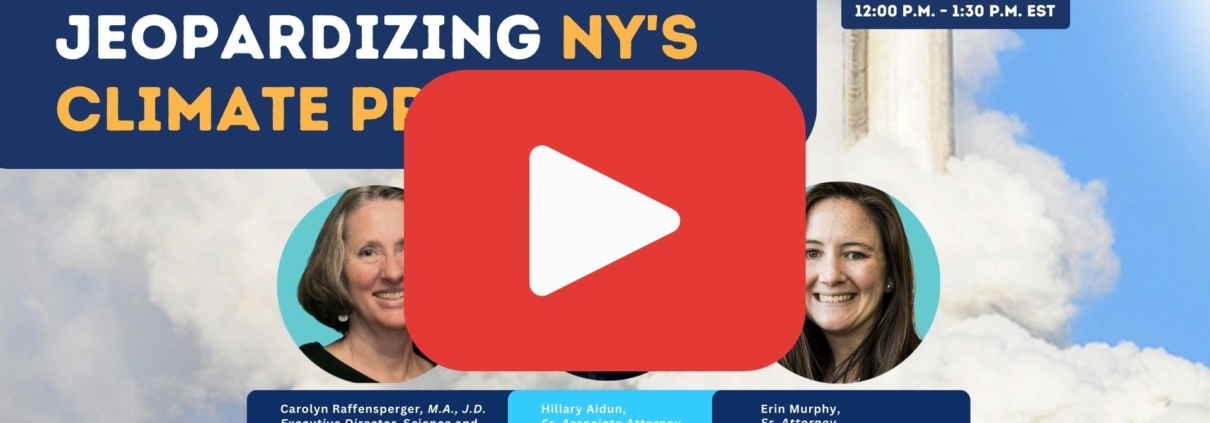
New York has set an ambitious climate plan to reduce greenhouse gas emissions, but false solutions threaten to derail progress. In this teach-in, we will examine three problematic solutions: so-called “renewable natural gas,” hydrogen blending for buildings, and carbon capture and storage, all of which could impede real climate action.

Guest Speakers:
● Hillary Aidun, Earthjustice
● Erin Murphy, Environmental Defense Fund
● Carolyn Raffensperger, The Science and Environmental Health Network

—————————————————————————–

Hillary Aidun, Senior Associate Attorney Earthjustice
A senior associate attorney in the Northeast Regional Office. Hillary works to advance environmental justice in the northeast region and advocates for meaningful and equitable implementation of New York’s climate law in state court and before administrative agencies. Before joining Earthjustice Hillary was a fellow at the Sabin Center for Climate Change Law at Columbia Law School, where she worked on expanding renewable energy resources, challenging federal regulatory rollbacks, and tracking New York State climate law.

Erin Murphy, Senior Attorney, Energy Markets & Utility Regulation
Areas of expertise: Natural gas and electricity market design, natural gas policy, utility regulation. Erin represents EDF in regulatory proceedings involving the design of wholesale and retail natural gas markets, seeking to facilitate the clean energy transformation. She advocates before state public utility commissions for gas supply planning mechanisms to prevent unneeded long-term investments in gas infrastructure, and for utility adoption of programs to reduce methane emissions from gas distribution networks. Erin also advocates before the Federal Energy Regulatory Commission for new and better ways to facilitate renewable energy integration and harmonize the wholesale natural gas and electricity markets.

Carolyn Raffensperger, Executive Director Environmental Health Network.
While working as an archaeologist in the desert Southwest of the U.S., she was enchanted by the beauty of the landscape and horrified at the environmental threats posed by dams, mining and toxic waste disposal. She left archaeology to work for the Sierra Club in Illinois. The desire to protect the rivers, prairie and desert led her to law school. Her graduate school training in archaeology and her law school education provides the tools Carolyn needs to serve her clients—the future generations of all species.
Building New York’s Clean Energy Workforce

On Monday, August 10, at 12:00 PM we discussed “Building New York’s Clean Energy Workforce: SUNY Morrisville & Ithaca Energy Warriors”. Our special guests were Dr. Ben Ballard, Professor of Renewable Energy at SUNY Morrisville, and Dr. Aloja Airewele, Cornell Cooperative Extension’s Energy Warriors Program Leader.

SUNY Morrisville has one of New York’s longest-running hands-on renewable energy education programs. Dr. Ballard’s presentation will highlight the degree programs, workforce training initiatives, and industry partnerships that prepare students for careers in solar, wind, clean heating and cooling, electrical systems, and energy project development.

The Energy Warriors Green Career Pathways program, directed by Dr. Airewele, provides training for people experiencing barriers to employment within the growing green jobs sector—including heat pump and solar installers, insulation technicians, and reuse specialists. This collaborative training program, grounded in the nationally recognized Roots of Success curriculum, brings together private employers, unions, public workforce development agencies, and educational organizations to provide paid training and a nurturing environment for their trainees.

In 2020 the Public Service Commission launched a Gas Planning Proceeding. The goals: to calibrate gas supply to avoid disruptions to service and direct the gas utilities to plan to meet the emissions reductions required by the CLCPA. Good planning is essential to ensure a smooth energy transition, strategically right-size the gas system, ensure that the right investments are made at the appropriate times, and to save ratepayers money. But so far, the gas planning has not yielded the necessary outcomes. Now in 2026, there’s an opportunity to reimagine gas planning and optimize our investments.

Featuring speakers:
Meagan Burton, Earthjustice
Kristina Persaud, Advanced Energy United
Josh Berman, Sierra Club

On Monday, February 9, from 12 to 1 P.M., NYCP’s Renewable Energy Speaker Series provided an insider’s view of offshore wind in New York State. Our special guest was Alicia Gené Artessa, Esq., Director of the New York Offshore Wind Alliance (NYOWA). Alicia explained why the benefits of offshore wind are critically important to all New Yorkers, including energy security, clean air, economic savings, job growth, revitalized port infrastructure, and protection of marine habitats. Our guest’s legal expertise, policy experience, and advocacy leadership allowed her to provide insight into the recent federal legal challenges to Empire Wind and Sunrise Wind, and to explain what we can do to support the advancement of offshore wind.

On Monday, January 12, from 12 to 1 P.M., NYCP hosted a practical guide to advocating for energy storage projects at town meetings. Our special guest was Vassar College professor Jeff Seidman, who drew on his successful effort to overturn Poughkeepsie’s energy storage moratorium. Dr. Seidman explained why the Hudson Valley is strategically crucial for energy storage, and why the area has become a flashpoint for energy debates, even within communities that are generally supportive of renewable energy. Most importantly, he presented compelling, persuasive arguments that we can use in almost any situation to support energy storage in our communities.

Join New Yorkers for Clean Power on Monday, February 10, noon to 1 P.M. for a discussion of Agrivoltaics—Supporting Farmer-Focused Solar. Our guests are Lucy Bullock Sieger, VP of Strategy from Lightstar Renewables (a member of NYSEIA), and Iain Ward, founder of SolAg Services. Iain is faculty with American Farmland Trust on a DOE-funded farmer technical assistance collaboration with Rutgers Agrivoltaics Program in NJ.

New York has set an ambitious climate plan to reduce greenhouse gas emissions, but false solutions threaten to derail progress. In this teach-in, we will examine three problematic solutions: so-called “renewable natural gas,” hydrogen blending for buildings, and carbon capture and storage, all of which could impede real climate action.

Missed this one? Find the recording here along with the presenters slides:

Take Action:

Sign up to go to Albany withttps://youtu.be/Wp9keIS_eroh Renewable Heat Now on Wednesday, January 29th: https://actionnetwork.org/events/renewable-heat-now-albany-rally-and-lobby-day


Guest Speakers:

● Hillary AidunEarthjustice

● Erin MurphyEnvironmental Defense Fund

● Carolyn Raffensperger, The Science and Environmental Health Network

—————————————————————————–

Hillary Aidun, Senior Associate Attorney Earthjustice A senior associate attorney in the Northeast Regional Office. Hillary works to advance environmental justice in the northeast region and advocates for meaningful and equitable implementation of New York’s climate law in state court and before administrative agencies. Before joining Earthjustice Hillary was a fellow at the Sabin Center for Climate Change Law at Columbia Law School, where she worked on expanding renewable energy resources, challenging federal regulatory rollbacks, and tracking New York State climate law.

Erin Murphy, Senior Attorney, Energy Markets & Utility Regulation Areas of expertise: Natural gas and electricity market design, natural gas policy, utility regulation. Erin represents EDF in regulatory proceedings involving the design of wholesale and retail natural gas markets, seeking to facilitate the clean energy transformation. She advocates before state public utility commissions for gas supply planning mechanisms to prevent unneeded long-term investments in gas infrastructure, and for utility adoption of programs to reduce methane emissions from gas distribution networks. Erin also advocates before the Federal Energy Regulatory Commission for new and better ways to facilitate renewable energy integration and harmonize the wholesale natural gas and electricity markets.

Carolyn Raffensperger, Executive Director Environmental Health Network. While working as an archaeologist in the desert Southwest of the U.S., she was enchanted by the beauty of the landscape and horrified at the environmental threats posed by dams, mining and toxic waste disposal. She left archaeology to work for the Sierra Club in Illinois. The desire to protect the rivers, prairie and desert led her to law school. Her graduate school training in archaeology and her law school education provides the tools Carolyn needs to serve her clients—the future generations of all species.