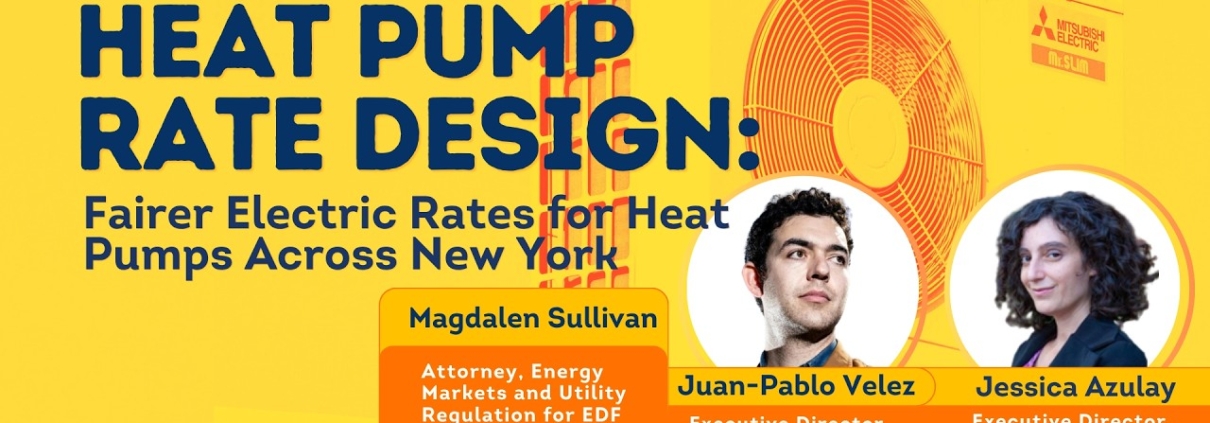
To achieve widespread adoption of heat pumps, it’s imperative to ensure that households switching from gas to heat pumps don’t see their bills go up. Fortunately there’s a solution! Currently, utilities are overcharging heat pump customers for the poles and wires that deliver electricity. Dedicated heat pump rates, like those already offered by Con Edison, can solve this.

Our esteemed speakers include Juan-Pablo Velez, Executive Director of Switchbox, Magdalen Sullivan, Attorney at the Environmental Defense Fund, and Jessica Azulay, Executive Director at AGREE.

The webinar covers a new report commissioned by AGREE and Earthjustice on heat pump rates. The report can be accessed at this link: https://www.switch.box/nyhprates

Study Two-Pager: https://renewableheatnow.org/wp-content/uploads/2026/05/switchbox_nyhprates_onepager.pdf

The teach-in includes an overview of the NY heat pump design working group’s plan to call on the NY Public Service Commission to take action on electric rate design in the “Grid of the Future” docket to ensure that electric heating customers are not overpaying for electricity and to help drive heat pump adoption across the state.
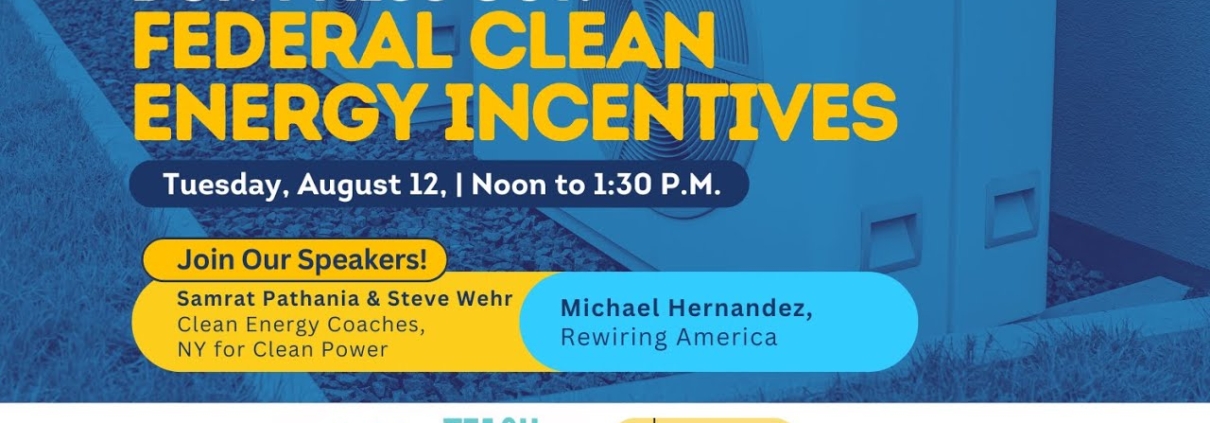

The Inflation Reduction Act created many incentives for clean energy upgrades such as EVs and heat pumps. Many of these rebates and tax credits will now expire in the next few months because of the “Big Beautiful” Budget Bill.

Watch for an overview of what the changes are and how to leverage these benefits before they disappear.

Speakers:
Michael Hernandez – Rewiring America
Samrat Pathania & Steve Wehr – Clean Energy Coaches, NY for Clean Power

New Yorkers are paying the price for outdated gas infrastructure. But there’s a better way. In this teach-in we dig into a new report from Switchbox that compares the cost of replacing leak-prone gas pipelines to the cost of fully electrifying the buildings those pipes serve.

The findings? Targeted electrification can save ratepayers billions—even when accounting for full electrification costs. We explored the report’s insights and how the NY HEAT Act can make these smarter investments possible.

Speakers:
Jessica Azulay – Executive Director, Alliance for a Green Economy (AGREE)
Juan-Pablo Velez – Executive Director, Switchbox

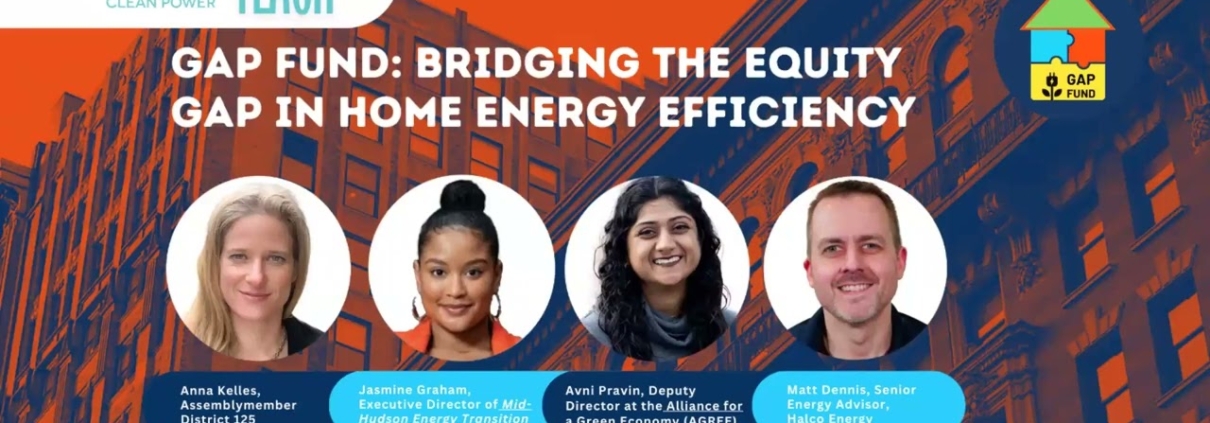
Join New Yorkers for Clean Power and the NY Energy Democracy Alliance for an interactive teach-in on the Green Affordable Pre-Electrification Fund, legislation that will help create a pathway to home energy upgrades for low and moderate income homes.

Our panelists include: Assemblymember Anna Kelles and State Senator Kristen Gonzalez, the lead sponsors of this crucial legislation, Jasmine Graham, Executive Director and Mid-Hudson Energy Transition, Avni Pravin, Deputy Director at the Alliance for a Green Economy (AGREE), Matt Dennis, heat pump and weatherization sales at Halco Energy, and Annie Carforo of WE ACT for Environmental Justice.

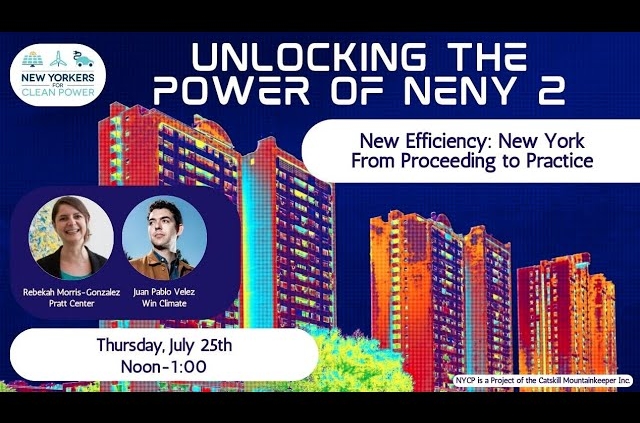
Did you know that New York has five BILLION dollars to spend on building energy efficiency and electrification over the next five years? In this NYCP Teach-In, we took a deep dive into the New Efficiency New York (NENY) Proceeding, which will determine how this money will be spent on building energy efficiency and building electrification in NYS from 2026-2030.

Our speakers included:
– Juan Pablo Velez, founder and executive director of the think tank, Win Climate presented his recent report: New Efficiency New York, an Appraisal of Past and Proposed Spendingt detailing how utilities and NYSERDA managed the first traunch of NENY money and how they propose to spend the next one. Read the report here: https://www.switch.box/neny

– Rebekah Morris-Gonzalez, Director of Climate Initiatives, at the Pratt Center for Community Development. Who presented on her report titled: “How NYSERDA’s Empower+ Program Shortchanges Low-Income Residents.” Read the report here: https://prattcenter.net/uploads/0124/1706652850133244/Empower_Brief_Final.pdf

New Yorkers need cleaner heat and lower bills. Tell Gov. Hochul, Speaker Heastie, and the NY Legislature to include the NY HEAT Act in the budget.

New Yorkers need cleaner heat and lower bills. Tell Gov. Hochul, Speaker Heastie, and the NY Legislature to include the NY HEAT Act in the budget.

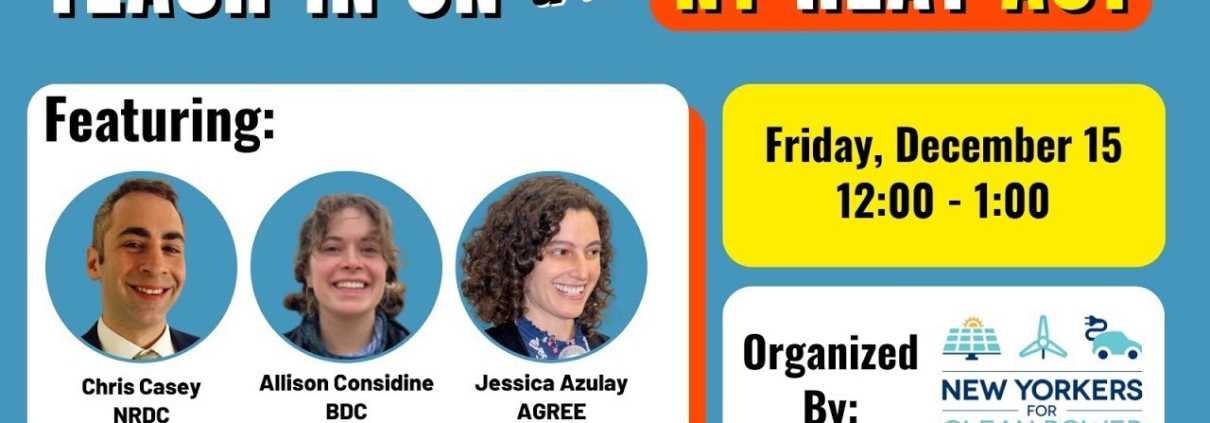
The NY Home Energy Affordable Transition (HEAT) Act (S.2016A/A.4592A) is a transformative climate and energy affordability bill that clears the path to investing in clean, modern, electric heating systems for all New Yorkers.

During this Teach-In, we learned more about this legislation and what we can do to help get it passed this session.

Our speakers included:
Chris Casey: Senior Attorney, Climate & Clean Energy Program for the Natural Resources Defense Council (NRDC)

Allison Considine: NY Senior Campaign & Communications Manager for the Building Decarbonization Coalition (BDC)

Jessica Azulay: Executive Director of Alliance for a Green Economy (AGREE)

Learn more about this legislation and how to get it passed at https://bit.ly/NYHEAT.

View the speaker slides here: https://nyforcleanpower.org/wp-content/uploads/2023/12/12.15.23-NY-HEAT-Act-Teach-In.pdf

This Teach-In explored the many ways to green our schools: from bringing hydroponic farming into our classrooms, to transitioning schools to all-electric heat pumps, to advocating for our schools to commit to net zero emissions, to state investments that make our schools healthier and more productive learning environments.

The Teach-In Featured:

– Emma Hines, Senior Associate Carbon Free Buildings at RMI

– Diana Michaelson, Senior at Long Beach Polytechnic High School

– Hannah Morgan, Senior Project Manager on the Efficiency Planning and Engineering Team at NYSERDA

– Manuela Zamora, Executive Director of New York Sun Works

New Yorkers for Clean Power presents Green the Grid & Electrify Everything, an engaging and illustrated walk through the Climate Act and all things Clean Power in New York. Green the Grid answers the questions you have and breaks down jargon to make the answers accessible to non-experts, while also including enough detail to engage policy enthusiasts. Come away energized and hopeful about the climate action path before us.

Part 3 focuses on buildings, specifically rural areas.